Startups & Innovation Events in Erding – Networking & Award
Startups & Innovation Events in Erding: Networking, Competitions and Paths to the Future
What would Erding feel like if, in the coming years, a viable startup emerged from an idea at the kitchen table—without founders necessarily having to move to the big city? And how would the region change if businesses, administration, tourism, and the tech scene worked even more closely together in the future?
Between church towers, proximity to the airport, and fast rail connections, an environment is growing that is still under the radar for many: founders, tech talents, creatives, and SMEs who test innovation, network at events, and gradually build their own ecosystem. What matters is not a single “big event,” but a recurring pattern: open formats (meetups, pitch nights, conferences), competitions (awards, challenges, funding calls), and collaborations with partners from the Munich metropolitan region.
This article takes a forward-looking approach to show how Erding can benefit from innovation formats in the metropolitan region—and how locals and visitors alike can get involved meaningfully.
Startup Scene in Erding: Opportunities Through Proximity to the Metropolitan Region
Erding is close to one of Germany’s most important startup and innovation hubs: the Munich metropolitan region. This brings a clear advantage for the coming years: founders can often start in Erding more calmly, cost-sensitively, and with more focus—while also using the region’s infrastructure (networks, skilled workers, proximity to universities and companies, investor contacts).
A change of perspective is important: those who see the “startup ecosystem” only as an inner-city phenomenon overlook the fact that modern innovation often arises regionally distributed. Many teams work hybrid, travel specifically to relevant appointments in the city, and build their pilot projects where real use takes place—in retail, gastronomy, leisure, mobility, or municipal services.
For Erding, this means as a vision for the future: not every idea has to be “based in Munich” to have an impact in Munich. What matters are the quality of the solution, demonstrable benefit, and reliable cooperation across city and district boundaries.
Competitions & Awards: How to Prepare for Upcoming Calls
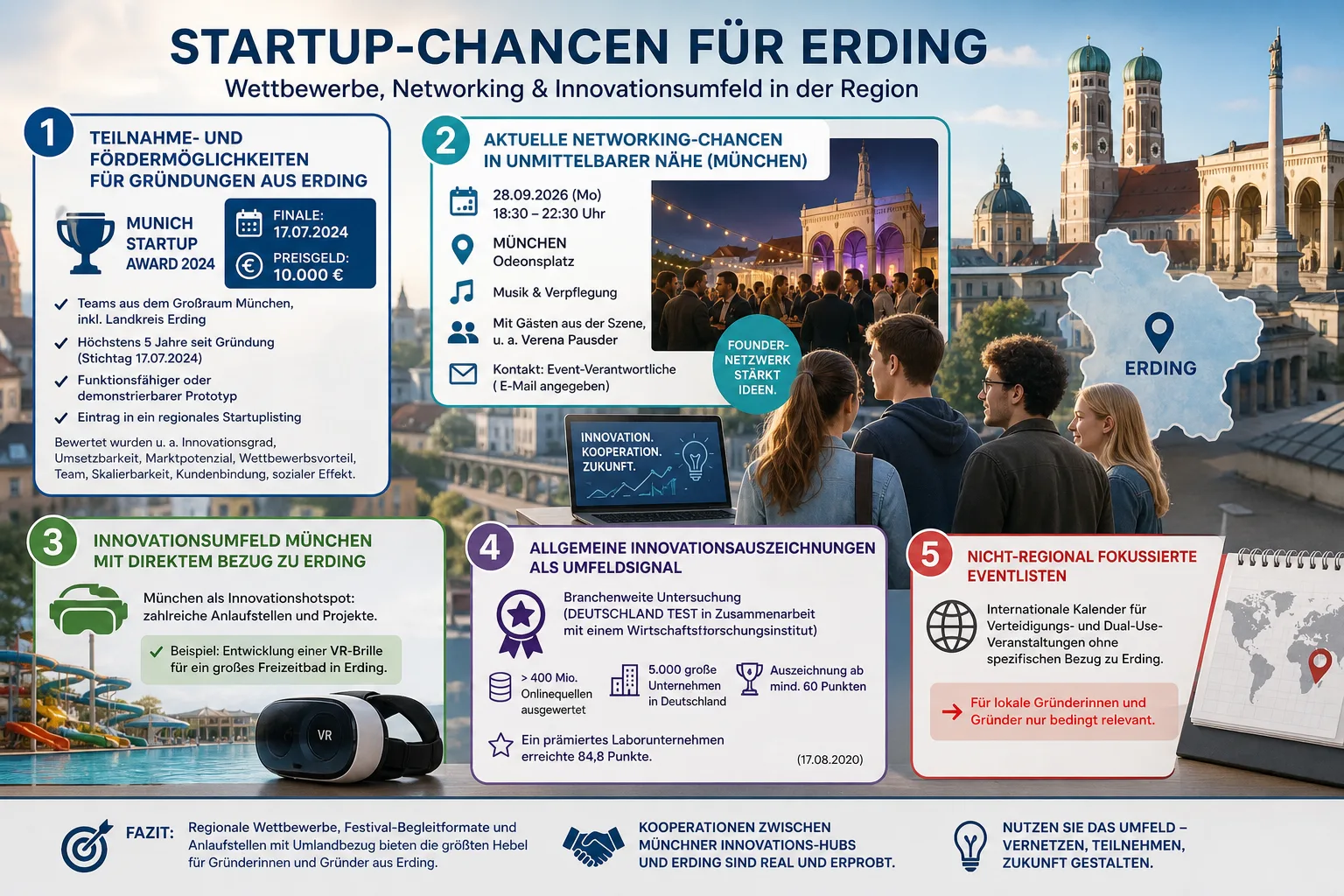
There are regular competitions, awards, and challenges in the metropolitan region that give startups visibility—often with pitch opportunities, media reach, access to mentors, or prize money. For teams from Erding, preparation is worthwhile because the requirements of many formats are similar and can be well “pre-built.”
What juries and programs typically require
- Clear problem definition: For whom are you solving which problem—and why is it urgent?
- Demonstrable solution: Prototype, MVP, or demo that shows the core function.
- Traction or learning curve: Tests, pilot customers, usage data, or solid feedback.
- Market and competition perspective: Why now—and what makes you different/better?
- Team fit: Can the founders implement the project operationally?
- Scalability & business model: How does revenue or impact arise—realistically, not just “slideware”?
- Responsibility & compliance: Data protection, security, transparency (depending on the sector).
How to make your project award-ready before the call starts
- A 1-minute pitch (problem → solution → target group → status → next step).
- A 6-slide deck (problem, solution, market, traction, business model, team).
- A demo that works on your own laptop without special setup.
- A proof package (test protocols, pilot agreements, references, metrics—as far as available).
- A clean data and security check (especially for apps, platforms, AI, or sensitive data).
Planning note: Since specific calls vary depending on the organizer, it makes sense to subscribe early to the relevant calendars/newsletters in the region and always keep your documents “application-ready.”
Networking & Events in Munich: How to Use an Evening Strategically
Many crucial contacts are not made in the meeting room, but during networking after panels, at pitch nights, or at thematic meetups. For teams from Erding, the hurdle is low: an evening appointment in Munich is usually manageable—and, if used correctly, can replace weeks of cold outreach.
Before the event (24–72 hours prior)
- Define your goal: Are you looking for pilot customers, co-founders, mentors, investors, or talent?
- Identify 3 desired contacts: From the agenda, speaker list, or community channels.
- Formulate a concrete “ask”: e.g., “We are looking for two pilot businesses in tourism for 6 weeks.”
- Prepare a short intro message: 3 sentences, no attachments, with demo link.
During the event (the 5-minute rule)
Good conversations are short, clear, and respectful:
- Be understandable in 30 seconds (no jargon, no buzzword chains).
- Spark interest in 2 minutes (give an example/use case).
- Clarify next step in 5 minutes (call, demo, intro, pilot check).
After the event (within 48 hours)
- Short follow-up referring to the conversation (1–2 sentences of context).
- A single, clear proposal (e.g., “15-minute demo on Wednesday?”).
- Document contact maintenance (CRM or simple list: date, topic, next step).
Takeaway: Networking is most effective when you don’t want “everything,” but the next realistic step.
Erding as a Test Field: Collaborations with SMEs, Tourism, and Public Actors
A robust innovation environment is evident in whether new solutions can be tested in real environments. Erding offers obvious, future-proof points of connection for this: tourism, leisure activities, gastronomy, retail, mobility, crafts, education, and municipal services.
Which pilot projects in Erding are particularly obvious in the coming years
- Digital guest services (booking, visitor guidance, multilingual information, low-barrier offers).
- Smart mobility (last mile, commuter services, multimodal route suggestions).
- Process digitization in SMEs (scheduling, warehouse/disposition, offer and invoice processes).
- Sustainability & efficiency solutions (energy and resource tracking, waste avoidance, transparent metrics).
- Further education & recruiting (skills programs, matching, onboarding tools).
This is how an idea becomes a serious pilot
- Set a hypothesis: What measurable improvement do you expect (time, cost, satisfaction, revenue, quality)?
- Define the framework: Duration, participants, effort, responsibilities.
- Clarify data protection & security: Minimal principle, consents, documented processes.
- Agree on measurement: Which KPIs count—and how are they collected?
- Define decision point: Rollout, adjustment, or stop—based on fixed criteria.
This way, Erding does not become a “backdrop,” but an active partner: a place where innovation is responsibly tested—with benefits for businesses, residents, and guests.
Practical Steps: Event and Networking Plan for the Next 90 Days
Anyone who wants to make measurable progress in the next three months needs less “inspiration” and more routine. The following plan is deliberately concrete—and without assumptions about individual, dated events.
Weeks 1–2: Laying the Foundation
- Test pitch & demo for 1 minute and 5 minutes (with 3 neutral people).
- Sharpen your profile: LinkedIn/website with clear target group, benefit, contact option.
- Event screening: Select 2–3 relevant series/communities (by industry or format).
Weeks 3–6: Visibility & Real Conversations
- Attend 2 events (meetup/pitch/panel) and make 3 new contacts per event with next step.
- Approach 1 pilot partner in Erding (with clear hypothesis & process plan).
- Build in a feedback loop: What is not understood? What convinces?
Weeks 7–12: Prepare for Application & Scaling
- Standardize documents: 6-slide deck, one-pager, demo link, short bio.
- Collect metrics (even small but clean data points count).
- Monitor competitions/programs and only apply where fit & timing are right.
For visitors and interested parties: Those visiting Erding in the coming months can best experience the city’s innovation side by consciously looking for open lectures, meetups, founder meetups, or calls for cooperation in the region—and by talking to local businesses where digital innovations are currently being planned or tested.