Experience Citizens' Assemblies & City Politics in Erding
Citizens' Assemblies & City Politics in Erding: How You Can Help Shape the City's Next Steps
How can an idea from a citizens' assembly later become a visible project in downtown Erding – such as a new bike lane, a greened square, or a meeting place for young people? In the coming months and years, participation in many cities will become more structured, more digital, and at the same time more local. This overview shows how citizens' assemblies work, which topics are likely to be in focus, and how you can prepare well in the future.
What Citizens' Assemblies in Erding Can Achieve in the Future
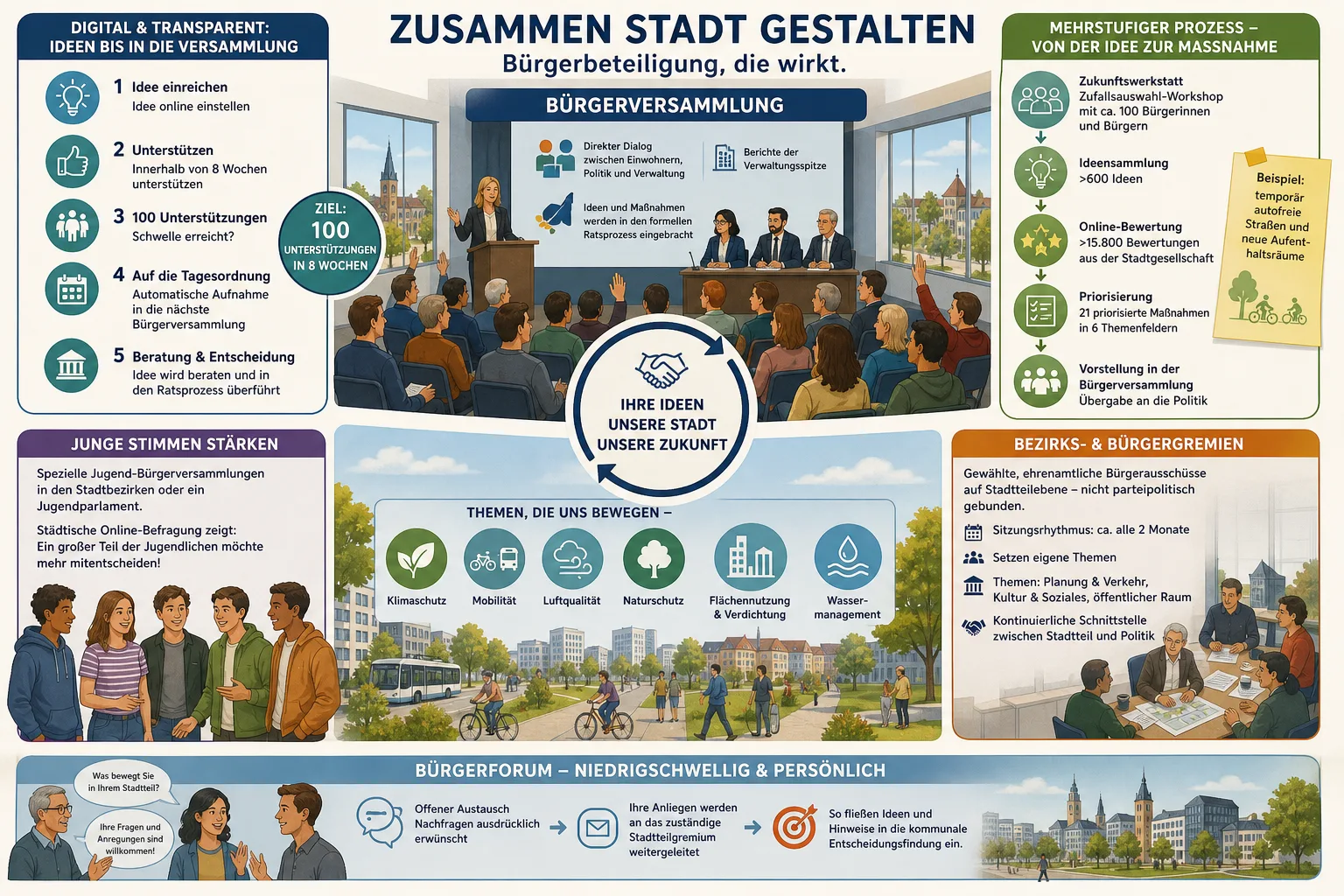
Citizens' assemblies are a central participation format of the municipality. In the future, they can offer you three things: first-hand information, a regulated space for questions and suggestions, and documented forwarding of topics to political committees.
Procedure: How a Citizens' Assembly is Typically Structured
- Report from the City: Information on ongoing projects (e.g., urban development, mobility, finances, climate protection) can be classified and summarized in an understandable way.
- Questions, Comments, Motions: Citizens can raise topics – from traffic safety in residential areas to strategic questions such as land use or heat protection.
- Documentation & Handover: Contributions can be recorded, bundled, and forwarded for discussion to the responsible committees or the city council.
If you participate in the future, the assembly can act as a "live update" for you: Which projects are coming up next? Where are decisions foreseeable? And where is it worthwhile to ask questions early before plans are finalized?
From Online Idea to Agenda: Digital Participation (Outlook)
In many municipalities, participation will be increasingly linked to digital platforms in the future. The goal is a transparent process in which ideas not only appear on one evening but can be visibly further developed over several steps.
This is What a Digital Participation Pipeline Could Look Like in the Future
- Submit Proposal: An idea is described online (e.g., greening, quality of stay, traffic safety).
- Gather Support: Other residents can support or comment within a set time window.
- Clear Threshold: If a previously set number of supporters is reached, the proposal can move to an appropriate participation format (e.g., citizens' assembly or committee).
- Public Discussion: The topic can be presented transparently, discussed, and prepared for political consultation.
- Tracking: The processing status can ideally be publicly documented in the future (review, responsibility, decision, implementation steps).
If digital participation is further expanded in Erding, it will be particularly important for acceptance that status updates are published reliably, understandably, and without unnecessary delays. This way, you can participate effectively even if you cannot be present in person on a given evening.
Which Topics Are Likely to Shape Erding's City Politics in the Coming Years
In citizens' assemblies, everyday questions and long-term decisions often come together. For Erding, it is foreseeable that many discussions will focus on recurring core areas:
- Climate Protection: Energy efficiency, local action programs, municipal goals, funding logic, and priorities.
- Climate Adaptation: Heat protection in the city center, more shade and greening, dealing with heavy rain, unsealing.
- Mobility & Safety: Cycling and walking, public transport connections, school routes, parking management, traffic calming.
- Land Use: Housing, commerce, green spaces, agriculture – and how goal conflicts are decided transparently.
- Water & Infrastructure: Drainage, drinking water, maintenance and renewal of technical infrastructure.
- Social Infrastructure: Childcare, care, meeting places, cultural and sports offerings.
If you want to prepare for upcoming citizens' assemblies, a simple focus helps: Formulate your concern so that responsibility and impact become clear. Good guiding questions are: Where exactly? Who is affected? Which solution is realistic? What side effects are to be expected?
Youth Participation: How Young People in Erding Can Have Their Say in the Future
Many cities will strengthen formats in the coming years that specifically reach young people. For Erding, two models in particular may become relevant:
- Youth Citizens' Assemblies: Events with youth-specific topics (recreational areas, safe school routes, affordable mobility, meeting places).
- Youth Parliament or Youth Advisory Council: A permanent body with the right to submit motions or be heard, which regularly works with administration and politics.
For youth participation to build trust in the future, one thing will be especially crucial: transparent feedback. When a proposal is reviewed, criteria should be transparent (e.g., safety, costs, land availability, legal situation, priorities) and the next step clearly stated.
Citizen Committees, Forums & Districts: Participation Closer to Everyday Life (Outlook)
In addition to large citizens' assemblies, decentralized formats may gain further importance in the coming years. District-based committees and open forums can help to gather concerns early and defuse conflicts before they escalate.
This is How District-Based Participation Formats Can Work in the Future
- Lower Entry Barrier: Topics can be raised earlier without already being formulated as "city council-ready."
- Concrete Local Reference: Paths, crossings, lighting, play and meeting places can be discussed directly on site.
- Mediation: District formats can moderate between different interests before decisions are made.
If you are unsure in the future whether a topic belongs in the citizens' assembly, a district-based format can be a suitable first step – especially when it comes to specific places, smaller measures, or recurring problems.
How You Can Make Practical Use of the Next Citizens' Assemblies in Erding
If you want to attend or follow citizens' assemblies digitally in the future, these steps will increase the effectiveness of your contributions:
- Plan Dates Early: Check the city's announcements in the future (website, official bulletin, notices, newsletter).
- Make Observations Concrete: Note the location, time, and specific situation (e.g., "crossing on weekdays in the morning, line of sight, speed").
- Provide a Solution Proposal: If possible, bring two options: an immediate measure (small, quick) and a medium-term solution (larger, more planning-intensive).
- Ask Questions So That Responsibility Is Clear: "Who decides? By when is a review possible? What criteria apply?"
- Follow Up: Later check minutes, decision lists, or committee documents to track the status of your topic.
If participation in Erding is consistently documented in the future, an important effect can arise for you: You will not only see that an idea was expressed, but how it is reviewed, prioritized, and – if decided – translated into implementation steps.