Volunteering & Engagement in Erding – Get Involved Here
Volunteering & Volunteer Work in Erding: How to Find Your Suitable Engagement from Now On
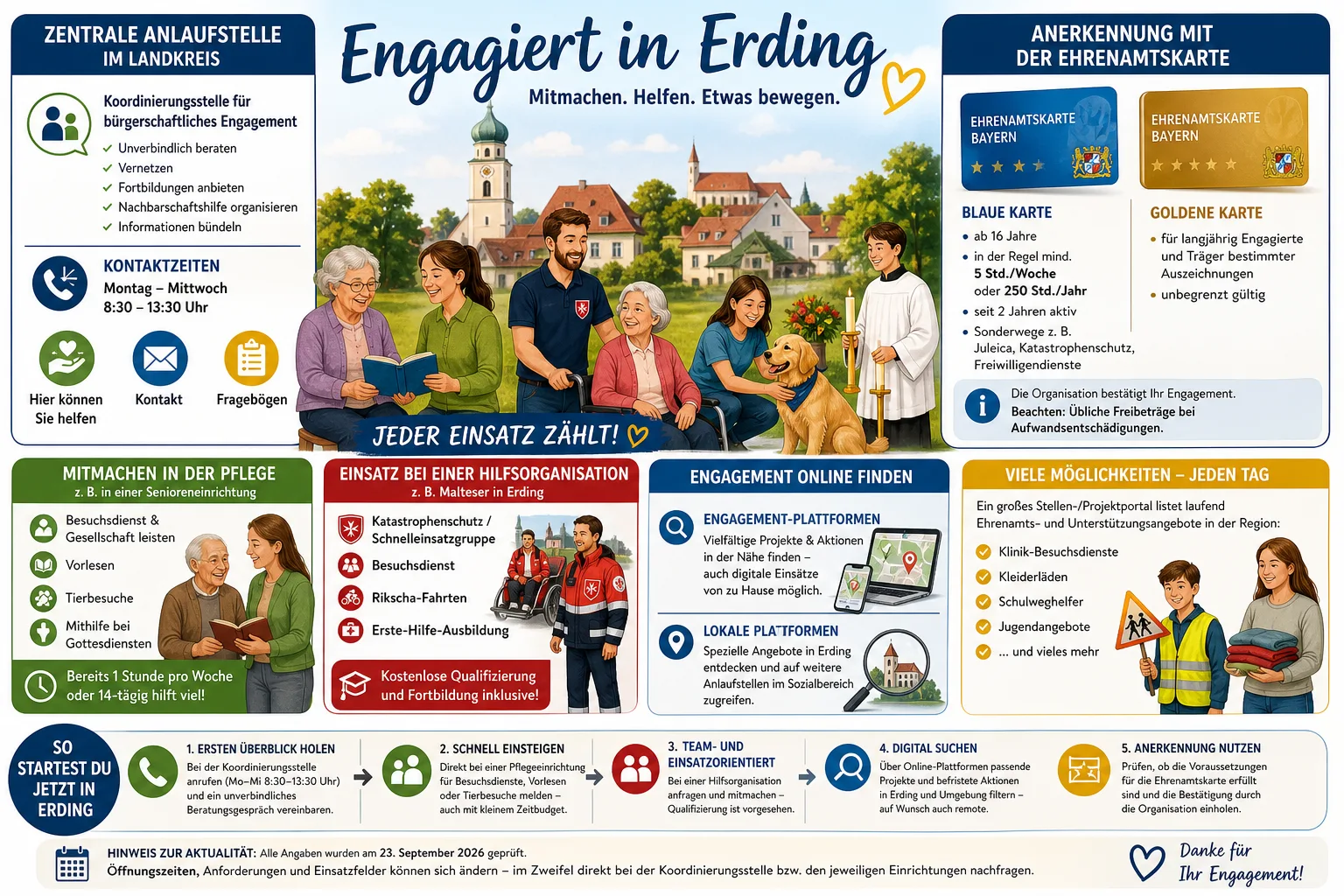
Would you like to get involved in Erding or the district – regularly or on a project basis, on-site or digitally? This guide shows you how to start in a structured way in the coming weeks, which areas of activity are typically open, and how to find reputable contact points as well as official information about the volunteer card.
Central Contact Points in the District of Erding (for Your Start in the Next Few Days)
For a quick, reliable start, official offices and established organizations are the best first address. This way you get up-to-date information about available opportunities, requirements (e.g. training), and contacts.
1) Volunteer/Engagement Coordination (District/Municipal)
Many districts and municipalities bundle engagement offers through a coordination office or a volunteer center. The advantage: You are usually matched according to needs, receive information about qualifications, and can have several options explained to you.
Next step: Check the official website of the district of Erding for current contact options, office hours, and possibly a request form for volunteer placement.
2) Welfare Associations, Churches, and Social Organizations
For visiting services, companionship, everyday support, or group activities, organizations such as welfare associations and church organizations are often particularly well structured. There are often introductions, fixed contacts, and clear role profiles.
3) Aid Organizations (Rescue Service, Disaster Relief, Medical Service)
If you are looking for teamwork, training, and clear procedures, aid organizations are a good entry point. Many offers start with information evenings, non-binding get-to-know meetings, and subsequent qualification paths.
Typical Areas of Activity in Erding – with Concrete Entry Paths
Visiting Service & Companionship (Seniors, People with Disabilities)
If you like to listen, give your time, and are reliably present, a visiting or companionship service is often a meaningful start. Typical tasks that are in high demand in the coming weeks:
- Conversations, reading aloud, walks together
- Accompanying to appointments (depending on the organization and conditions)
- Support with small everyday errands (e.g. shopping together)
How to start: Contact a social institution or an organization with a visiting service offer and ask for a get-to-know conversation as well as a short introduction (data protection, dealing with boundaries, emergency contact).
Disaster Relief & Medical Service
Here, teamwork, willingness to train, and reliability count. Entry usually takes place in stages so that you learn the procedures step by step. In the long term, you can (depending on the organization) develop into areas such as medical service, care, logistics, or technology.
How to start: Find the local branches in your place of residence in the district of Erding and register for an upcoming information evening or a non-binding trial session.
First Aid Training & Educational Offers
If you like to share knowledge, roles in training and prevention are a good fit (e.g. supporting course organization or – after qualification – teaching activities). Structured training is common in this area.
How to start: Ask recognized providers (e.g. aid organizations) which entry roles are currently possible and which qualification is planned as the next date.
Neighborhood Help & Everyday Support
Neighborhood help is often low-threshold – and at the same time effective. Frequently sought: short-term support with small errands, companionship, or coordination within a neighborhood.
How to start: Use municipal/regional placement agencies or reputable platforms (see next section) so that tasks, liability, and contacts are clearly regulated.
Digital Volunteering (Flexible from Home)
Even without fixed on-site appointments, you can make a meaningful contribution in the coming months – depending on the project, for example through:
- Online mentoring and learning support
- Translation or text support (e.g. for associations)
- Organization, scheduling, public relations
How to start: Use established engagement platforms with regional search and verifiable organization profiles. A well-known entry option is the platform of Aktion Mensch, which filters offers by location and activity.
Volunteer Card: Recognition & Next Steps for Application
In Bavaria, there is the Bavarian Volunteer Card as recognition for voluntary engagement. Requirements, validity, and specific benefits are officially regulated and may be updated depending on the program status.
How to proceed in the next steps:
- Check official criteria: Find out about current requirements and card variants on the Bavarian Volunteer Card website.
- Clarify proof: Talk to your organization/club management about which confirmation is required in the application process.
- Find the current contact point in the district of Erding: On the district's or responsible office's websites, you will find where applications are to be sent and which documents are currently required.
If you are just starting: Set yourself the goal of choosing your engagement so that it is realistically possible in the long term. Recognition is a bonus – the right task is the foundation.
Qualification, Insurance & Expense Allowance: What You Clarify Before Starting
For trustworthy, safe volunteering, you should actively address three points before your first assignment. Reputable organizations welcome these questions.
- Introduction & Contact Person: Is there an introduction (e.g. data protection, dealing with vulnerable people, emergency procedures) and a fixed contact person?
- Insurance Coverage: How are volunteers insured during their assignment (e.g. accident/liability – depending on the organization and activity)?
- Expense Allowance: If there are reimbursements (e.g. travel expenses), ask about the internal regulation and the tax classification. Official guidance is provided, among others, by the Federal Ministry of Finance (e.g. information on volunteer/coach allowances).
Especially in areas with children, young people, or vulnerable people, additional requirements may apply (e.g. extended certificate of good conduct or mandatory training). Allow time for this in your planning.
7-Day Checklist: Your Entry into Volunteering
- Day 1: Note your time budget, your topics, and whether you want fixed appointments.
- Day 2: Find 3–5 suitable offers (municipal website, organizations, reputable platforms).
- Day 3: Write two short inquiries (who you are, when you are available, what you are looking for).
- Day 4: Have a get-to-know conversation (by phone or on-site) and have tasks & framework explained to you.
- Day 5: Clarify introduction, contact person, insurance, and if necessary, proof.
- Day 6: Arrange your first trial appointment or observation appointment.
- Day 7: Make a conscious decision: Does the task fit? Does the organization fit? If yes: Set up a series of appointments.
This way, "I would like to help" becomes a concrete, plannable start within a week – without overwhelm and without unclear expectations.
Sources
- Bavarian Volunteer Card (official program) — Requirements, variants, application (accessed 2026-09-23)
- Federal Ministry for Family Affairs, Senior Citizens, Women and Youth (BMFSFJ) — Framework information on engagement and volunteering (accessed 2026-09-23)
- Aktion Mensch – Engagement Platform — Nationwide search for engagement opportunities (accessed 2026-09-23)
- Federal Ministry of Finance (BMF) — Tax information on voluntary work (e.g. allowances) (accessed 2026-09-23)